Stride Length vs Q-Factor: Your Fit Guide
By Amir Qureshi • 11th Mar

When you're shopping for an elliptical, you'll hear two terms thrown around almost interchangeably (and that's the problem). Stride length and Q-factor are distinct measurements that work together to determine whether a machine feels natural or awkward on your knees and hips. Confusing them leads to the most common regret I hear: "It looked right on paper, but it felt wrong from day one."
Let me untangle these, give you the numbers that matter, and show you a simple at-home test to dial in your fit.
What's the Difference Between Stride Length and Q-Factor?
Q: Aren't stride length and Q-factor the same thing?
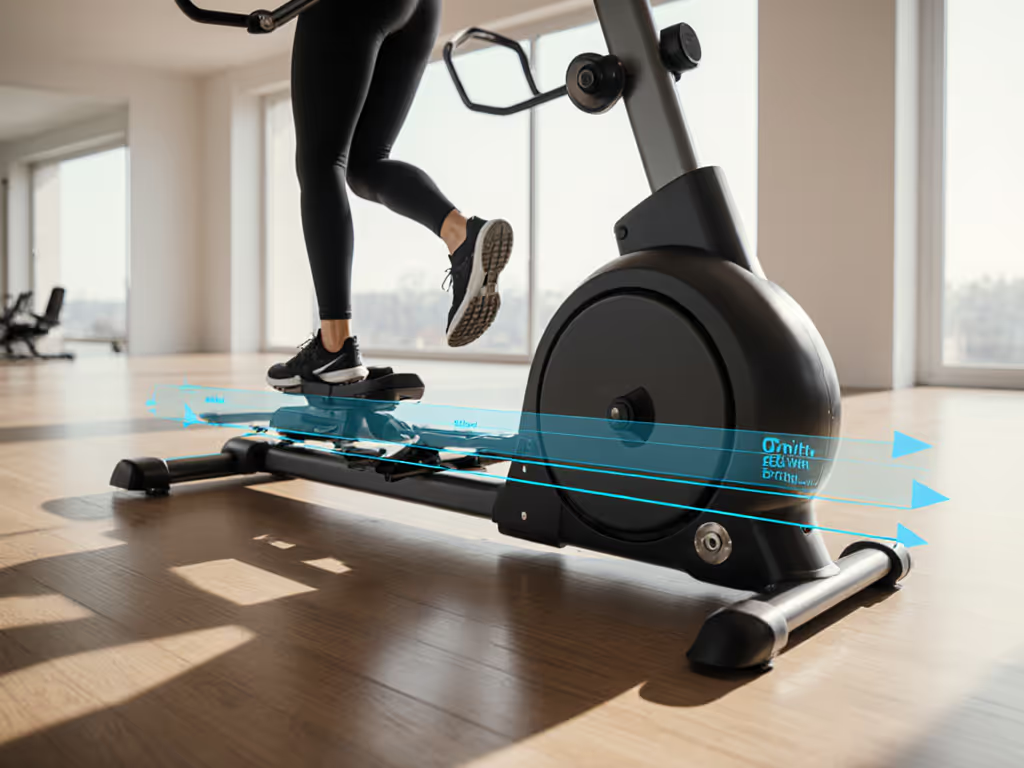
A: No, and this confusion costs people money and comfort. Stride length is the distance your foot travels from the highest pedal position to the lowest during one full revolution. It's measured front-to-back in inches (typically 16-22 inches on home machines). Q-factor is the lateral distance between your pedals, how far apart they sit side-to-side, measured in millimeters. Think of it this way: stride length determines whether the step feels short and choppy or long and flowing. Q-factor determines whether your knees track straight or splay outward.
Stride is about range of motion. Q-factor is about alignment and joint angle. For how drive systems change stride feel, see our front-, rear-, and center-drive comparison.
Why Does Stride Length Matter?
Q: How do I know what stride length fits me?
A: Your inseam (the inside seam of your pants from crotch to ankle) is your starting point. A good rule: aim for a stride that's roughly 50-70% of your inseam. If your inseam is 28 inches, a 17-19 inch stride is usually comfortable. If you're 6'2" with a 32-inch inseam, you'll want 20-22 inches. Too short and you'll feel cramped and want to stand up constantly. Too long and you'll hyperextend your knee at the bottom, which pinches your patella and hip flexor. If you're over 6 feet, our stride length guide for tall users lists machines with 20-22 inch strides.
I learned this the hard way. After a winter of knee twinges, I taped my living room floor and tested stride reach with a simple wall-to-toe drill: standing upright, one foot against a wall, measuring how far forward I could extend the other leg with a straight knee. That distance told me I needed a 20-inch stride. Use our step-by-step Stride Length Calibration guide to replicate this at home. When I swapped machines, the pinch disappeared within a week.
Measure your stride once; choose comfort for every workout.
What Does Q-Factor Do?
Q: Why should I care about millimeters between pedals?
A: Because millimeters add up to joint stress. Q-factor is essentially the width of your pedal stance. Most people sit 140-180 millimeters apart at the hip when standing neutral. If your elliptical pedals are 200+ mm apart, you're abducting (spreading) your knees outward the whole workout. Over 30-45 minutes, that's fatigue and eventual discomfort in the lateral knee and outer hip.
Narrow Q-factors (100-120 mm) mimic running and walking more closely, keeping your knees stacked under your hips. This is especially critical if you have knock-knees (valgus alignment), history of IT-band tightness, or wobble in your stride. A narrower Q-factor reduces that twisting torque.
Stride Length vs Q-Factor: How Do They Work Together?
Q: Can a machine have a great stride but poor Q-factor?
A: Absolutely, and this is where the sales pitch breaks down. A 20-inch stride is useless if the pedals are 220 mm apart, because your knees will protest before you even settle into a rhythm. Conversely, a 16-inch stride with a 110 mm Q-factor might feel stable and aligned, but it'll feel choppy and short if you have a 32-inch inseam.
You need both specs to match your body. Think of it as a two-step fit check:
- Does the stride match my leg length and reach? (tape measure test)
- Do the pedals sit directly under my hips? (stance-width test)
If either one is off, the machine won't feel intuitive, and you'll compensate with poor posture, leaning on the handles, hiking one hip, or truncating your stride. That's when injury risk climbs.
How Do I Measure My Fit at Home?
Q: Can I test this before I buy?
A: Yes. Do this now, before you even look at spec sheets.
Stride test: Stand barefoot, one foot flat, one foot extended straight behind you with your knee locked. Measure from the heel of your planted foot to the toe of your extended foot. That's roughly your maximum front-to-back reach. If you measure 22 inches, aim for an 18-20 inch stride; you'll have room to extend without overreaching.
Q-factor test: Stand in your normal athletic stance, feet hip-width apart. Have someone measure the distance between the centers of each foot. (Easier method: stand feet together, then step each foot outward about 3 inches. That's close to hip width.) Most people sit 140-170 mm apart at the ankles when neutral. If your elliptical pedals are 100-130 mm apart, they'll track under your hips. Anything above 160 mm will feel wide.
You don't need calipers. A tape measure and five minutes will tell you what you're actually looking for.
What If I'm Stuck Between Two Machines?
Q: One machine has perfect stride but wider Q-factor. The other is the reverse. Which do I choose?
A: Prioritize Q-factor, especially if you have any history of knee discomfort or lateral hip tightness. A narrower Q-factor (110-130 mm) protects your knees over time; you can compensate for slightly short stride by increasing cadence (revolutions per minute). You cannot compensate for bad Q-factor, it's a structural constant, and poor alignment compounds with every step.
If neither is ideal, walk away and find a machine that splits the difference or matches your measurements more closely. The machine should adapt to your body, not the other way around. Fit beats features every time.
Multi-User Fit: When Partners Have Different Heights
Q: My partner is 5'4", I'm 6'0". Can one machine work for both?
A: Yes, if it's adjustable. Some ellipticals offer adjustable stride or movable pedal positions, which shift effective stride length and Q-factor slightly. More commonly, you'll use fixed stride; the shorter partner will feel a bit more open, and the taller partner a bit more compressed. This trade-off is acceptable if the machine's stride is in the middle zone (18-20 inches) and Q-factor is narrow (120 mm or less).
If one of you is well outside the typical range, a one-size-fits-most machine will frustrate at least one user. In that case, measure both inseams, calculate each ideal range, and look for overlap. If your inseams are 26 and 34 inches (an 8-inch gap), a 19-inch stride is a reasonable middle ground; a 110 mm Q-factor works for nearly everyone.
The Real-World Impact: Pain-Free Longevity
Q: Does stride length and Q-factor really prevent injury?
A: They don't guarantee injury prevention, that's a medical claim I won't make. But proper alignment reduces cumulative load on your knees and hips. Over 3-5 years of 3-4 workouts per week, poor geometry adds up: cartilage wear, lateral knee tracking, hip flexor tightness. Users with well-matched stride and Q-factor report fewer tweaks, more consistency, and longer workout sessions without discomfort. To keep alignment dialed in during workouts, follow our elliptical form guide.
The data is indirect but compelling: runners who log miles on machines with poor stride often drift back to running outdoors, citing "it just feels off." Conversely, people who match their fit report using the machine 2-3 years longer before abandonment.
Summary and Final Verdict
Stride length and Q-factor are separate measurements, each critical to comfort and longevity.
Start here:
- Measure your inseam and calculate your ideal stride range (50-70% of inseam).
- Test your hip width and note that most people sit 140-170 mm apart at the stance.
- Look for an elliptical with stride in your range and Q-factor between 100-130 mm.
- If specs are missing or vague, that's a red flag: the manufacturer doesn't prioritize fit.
- Prioritize Q-factor if you must choose; stride is easier to adapt to than alignment.
You'll spend 1-2 hours per week on this machine. It deserves a tape measure and five minutes of homework now, not regret in two months. Measure your stride once; choose comfort for every workout.
Related Articles